How to Choose 100% Viscose Spunlace for Wet Wipes?
Why Do Wet Wipe Brands Choose 100% Viscose?
Wet wipe manufacturers normally need to balance softness, absorbency, strength, environmental positioning, and cost. —— 100% Viscose Spunlace for Wet Wipes
Polyester and viscose blends are widely used because polyester improves strength. However, some brands do not want synthetic fibers in the wipe substrate. They may also want a softer material or a product made entirely from cellulose-based fibers.
In these cases, 100% Viscose Spunlace for Wet Wipes becomes a practical option.
It is commonly considered for:
- Baby wipes
- Facial cleansing wipes
- Makeup remover wipes
- Personal hygiene wipes
- Adult care wipes
- Premium skincare wipes
- Some light household wipes
Still, 100% viscose is not automatically the best choice for every wet wipe. Its performance depends on the fiber grade, fabric weight, web structure, hydroentanglement quality, and surface pattern.
What Is 100% Viscose Spunlace for Wet Wipes?
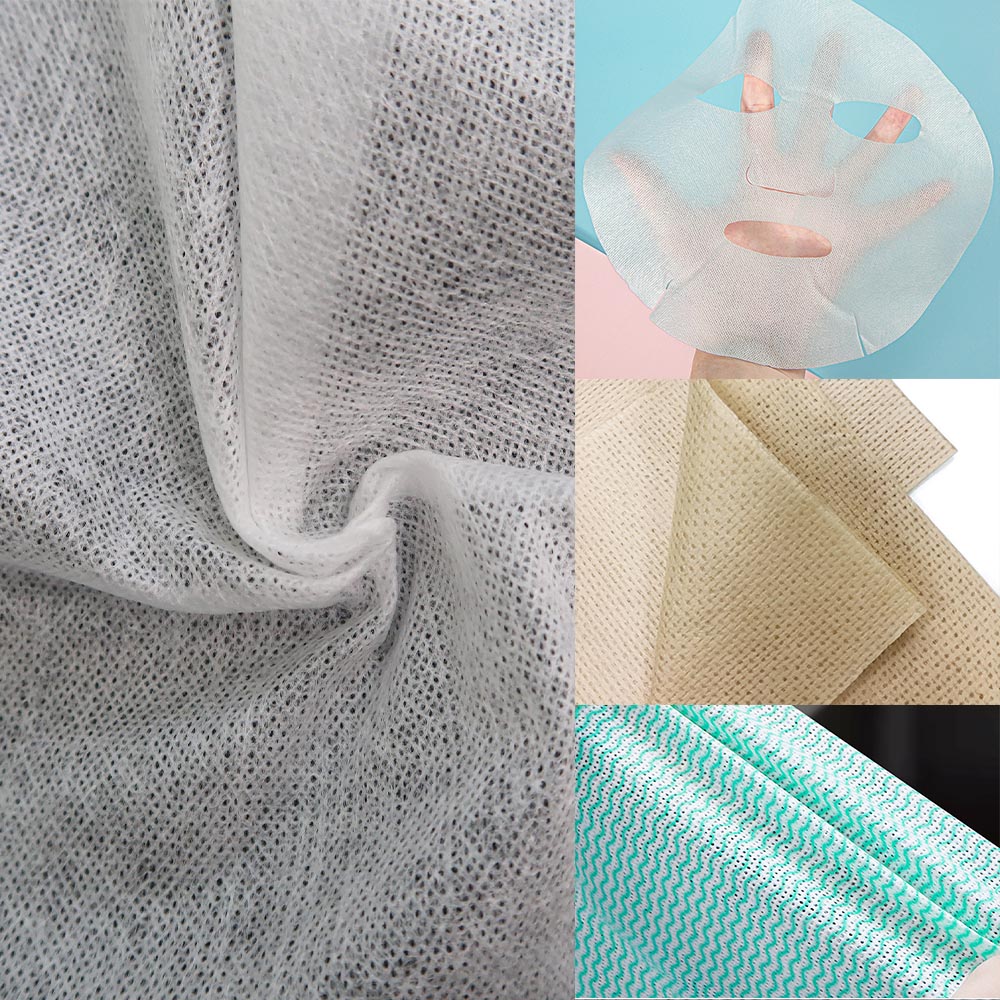
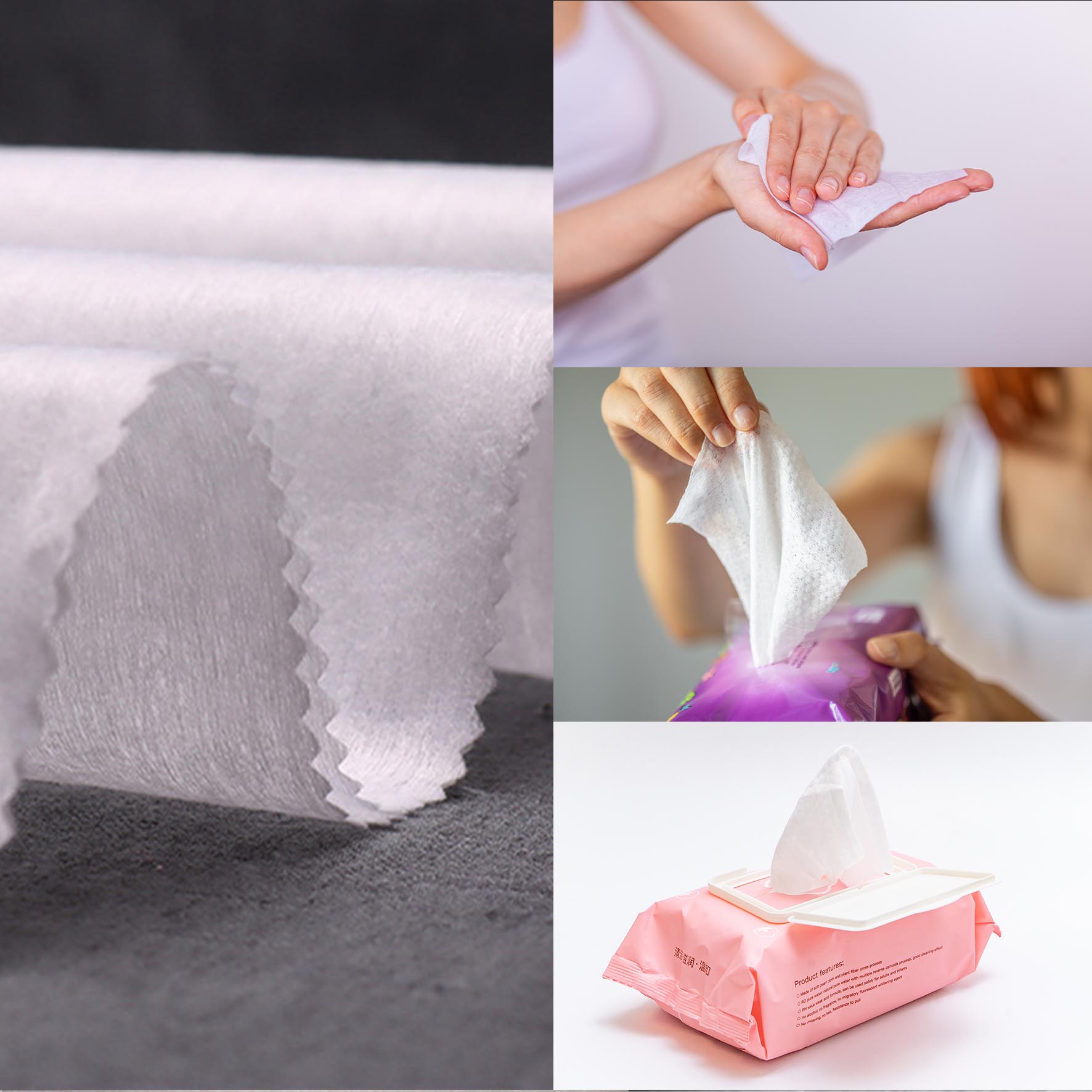
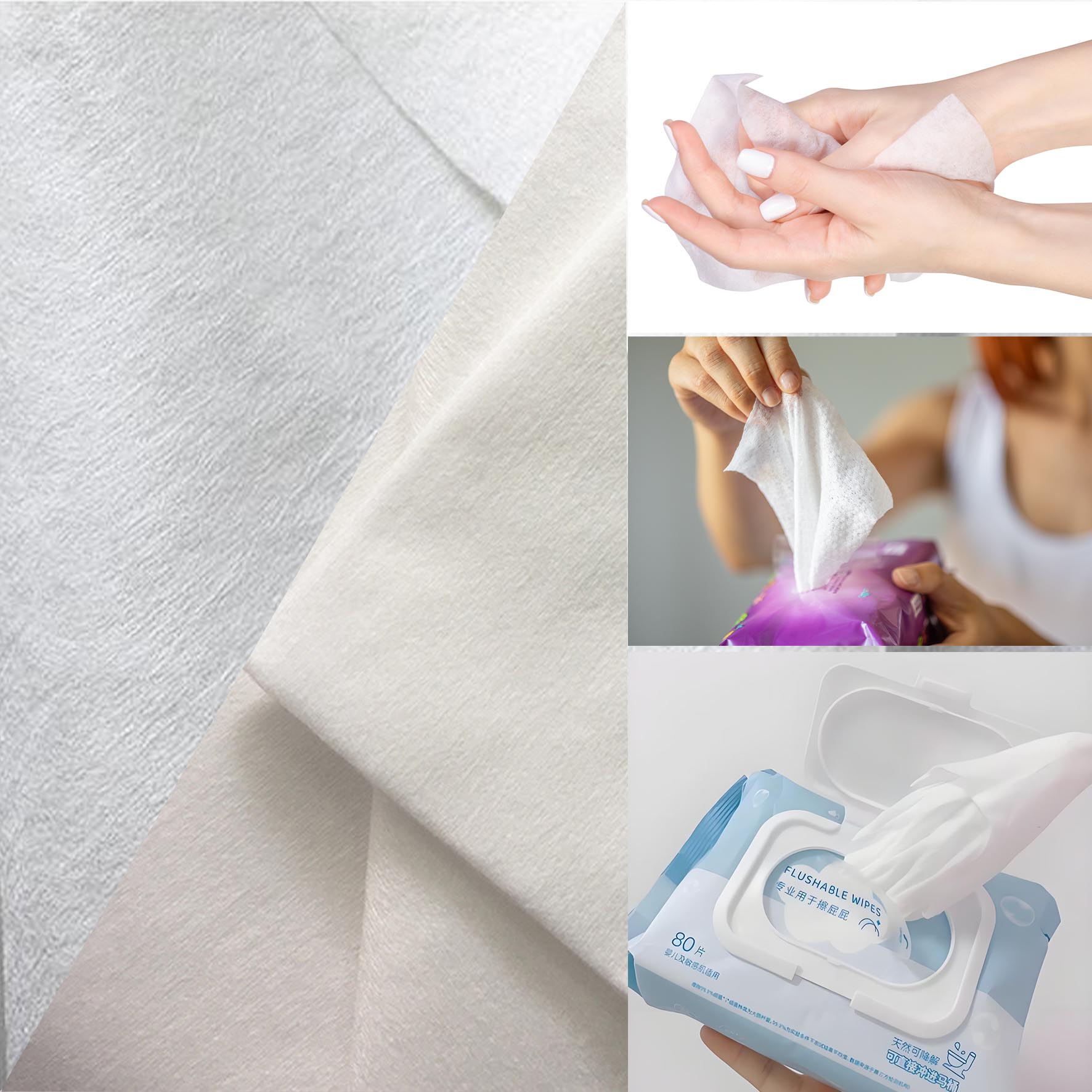
100% Viscose Spunlace for Wet Wipes is a nonwoven substrate made entirely from viscose fibers and bonded through high-pressure water jets.
Viscose is a regenerated cellulose fiber, normally produced from wood pulp. It is not the same as raw natural cotton, but it is cellulose-based and does not contain conventional polyester when the composition is genuinely 100% viscose.
During spunlace production, opened viscose fibers are formed into a web. Fine water jets then entangle the fibers without weaving or knitting them.
The resulting material generally provides:
- Soft skin contact
- Fast liquid absorption
- Good lotion distribution
- A cloth-like touch
- Low synthetic-fiber content
- Good suitability for disposable personal care products
One detail is important: “100% viscose” describes the fiber composition. It does not tell you everything about the fabric’s softness, strength, cleanliness, weight consistency, or converting performance.
Two suppliers can both offer 100% viscose spunlace but deliver noticeably different results.
What Are Its Main Advantages and Limitations?
A trustworthy material guide should explain both sides.
| Area | Main Advantage | Possible Limitation |
|---|---|---|
| Softness | Comfortable for frequent skin contact | Softness varies by fiber and process |
| Absorbency | Takes up water and lotion efficiently | High absorption can increase lotion consumption |
| Wet strength | Suitable for many personal care wipes | Usually lower than polyester-rich blends |
| Product positioning | Supports cellulose-based and plastic-free substrate concepts | The complete wipe and packaging may still contain plastic |
| Appearance | Clean, soft and premium-looking | Poor-quality fibers may cause unevenness or lint |
| Cost | Suitable for mid-range and premium wipes | Usually costs more than polyester-rich alternatives |
| Disposal | Cellulose-based fiber composition | It is not automatically flushable |
This means 100% viscose works best when softness and absorbency are more important than maximum tear resistance.
For a heavy-duty disinfecting wipe or industrial cleaning cloth, adding polyester may provide better durability. For a baby wipe or facial wipe, the softer 100% viscose option may be more attractive.
How Should You Choose the Viscose Fiber?
Choosing the fiber is the first step. Buyers should not evaluate only the finished GSM.
1. Check the Actual Fiber Composition
Ask the supplier to confirm that the material is genuinely 100% viscose.
Some products are described as “viscose wipes” even though they contain:
- Polyester
- Polypropylene
- Other synthetic support fibers
A blended material is not necessarily poor quality. However, its composition should be clearly stated so that packaging claims remain accurate.
2. Consider Fiber Fineness
Finer viscose fibers can help create:
- A smoother surface
- Softer hand feel
- More uniform coverage
- Better suitability for facial and baby wipes
However, an extremely fine construction is not always stronger. It may also require better carding and hydroentanglement control.
Slightly coarser fibers can increase bulk and provide a fuller touch. They may work well for thicker personal care wipes.
The best fiber fineness therefore depends on whether the product needs a silky surface, a bulky feel, or greater wiping friction.
3. Check Fiber Length and Web Formation
Fiber length affects entanglement and fabric strength.
Longer fibers generally provide more opportunities for mechanical entanglement. However, the production line must distribute them evenly.
If fiber opening and carding are poorly controlled, the finished fabric may show:
- Thin spots
- Thick areas
- Uneven texture
- Unstable MD and CD strength
Rather than asking only for the fiber length, buyers should examine the finished fabric’s uniformity and tensile performance.
4. Pay Attention to Cleanliness and Consistency
Wet wipes often come into direct contact with skin. Fiber quality should therefore be stable from batch to batch.
Buyers can ask about:
- Fiber source
- Whiteness consistency
- Foreign-fiber control
- Odor
- Visible impurities
- Available safety or skin-contact test documents
A brighter white color does not automatically mean better quality. Excessive emphasis on whiteness can distract from more important issues such as cleanliness, softness, and lotion compatibility.
5. Match the Fiber to the Wet Wipe Formula
The substrate and lotion should be tested together.
Viscose absorbs liquid well, but the finished wipe must still release enough lotion during use. A material that holds liquid too tightly may feel less moist to the consumer.
Special attention is required for disinfecting formulas containing quaternary ammonium compounds. Standard viscose can interact with some active ingredients, so the finished formulation should be tested rather than judged from the dry fabric alone.
What GSM Should You Choose?
There is no universal GSM that works for all wet wipes.
The following ranges are practical purchasing references rather than fixed industry standards.
| GSM Range | Typical Positioning | Suitable Applications | Buying Consideration |
|---|---|---|---|
| 35–45 GSM | Lightweight and economical | Travel wipes, simple personal care wipes | Lower material cost but thinner hand feel |
| 45–55 GSM | Mainstream | Baby wipes, personal hygiene wipes | Good balance of softness and cost |
| 55–65 GSM | Premium | Thick baby wipes, facial wipes, adult care wipes | Fuller touch and stronger premium image |
| 65–80 GSM | Heavy and luxurious | Skincare wipes, spa wipes, large adult care wipes | Higher cost and greater lotion demand |
| Above 80 GSM | Specialty | Extra-thick or reusable-style disposable wipes | Requires careful converting and packaging evaluation |
Is Higher GSM Always Better?
No.
Increasing GSM may improve:
- Thickness
- Bulk
- Liquid capacity
- Perceived quality
But it may also increase:
- Material cost
- Lotion consumption
- Pack weight
- Transportation cost
- Folding and dispensing difficulty
A 60 GSM wipe is not necessarily better than a well-made 50 GSM wipe. Good fiber distribution and suitable hydroentanglement can make a lighter fabric perform surprisingly well.
Recommended Starting Points by Application
For a new project, these ranges can be used as an initial sampling guide:
- Standard baby wipes: approximately 45–55 GSM
- Premium baby wipes: approximately 55–65 GSM
- Facial cleansing wipes: approximately 45–65 GSM
- Makeup remover wipes: approximately 50–70 GSM
- Adult care wipes: approximately 55–75 GSM
- Light household wipes: approximately 55–80 GSM
The final decision should be made after testing the converted wipe, not only the raw roll.
Which Surface Pattern Is Suitable?
The pattern affects appearance, softness, thickness, wiping ability, and product differentiation.
Plain Spunlace
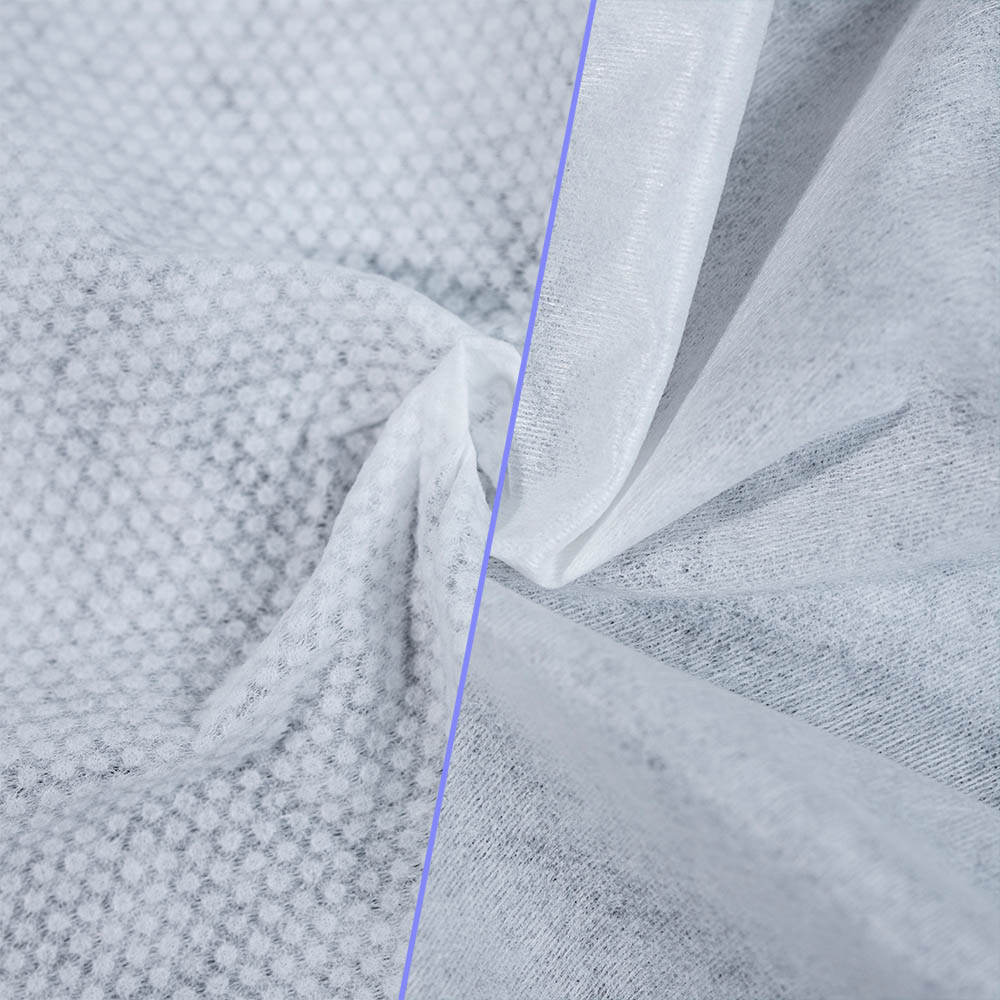
Plain fabric has a relatively smooth and simple surface.
It is commonly chosen for:
- Baby wipes
- Sensitive-skin wipes
- Facial wipes
- Daily personal care wipes
Its main advantages are softness and even skin contact.
Plain fabric is also easier for brands that want a simple, clean product image. However, it may offer less visible bulk and lower dirt-pickup performance than textured designs.
Pearl or Dot Pattern
Pearl, dot, bubble, or similar raised patterns can make the fabric look thicker and more distinctive.
They are often selected for:
- Premium baby wipes
- Personal hygiene wipes
- Adult care wipes
- Branded consumer wipes
Possible benefits include:
- Fuller hand feel
- Better visual differentiation
- Increased surface contact
- Improved perception of thickness
The pattern depth should still be controlled. A very strong texture may feel less gentle on sensitive skin.
Mesh or Apertured Pattern
Apertured fabric contains visible holes or an open mesh-like structure.
It can help with:
- Picking up dirt
- Removing makeup
- Capturing residue
- Releasing lotion during wiping
It is often considered for:
- Facial cleansing wipes
- Makeup removal products
- Household wipes
- Specialty cleaning wipes
For newborn baby wipes or very sensitive skin products, a softer plain or light embossed design may be more suitable.
Custom Pattern or Logo
Hydroentanglement technology can also create customized patterns, letters, or brand-related designs.
This helps brands differentiate their products, but buyers should consider:
- Pattern development cost
- Minimum order quantity
- Tooling requirements
- Effect on fabric strength
- Whether the design remains visible after lotion is added
- Compatibility with folding and cutting equipment
A custom pattern should improve the product experience, not only its appearance.
How Do GSM and Pattern Work Together?
GSM and pattern should not be selected separately.
For example:
- A low-GSM fabric with deep embossing may look bulky but have weak areas.
- A high-GSM plain fabric may feel thick but lack cleaning texture.
- An apertured design may improve wiping but reduce local strength if the structure is too open.
- A light pearl pattern may give a 50 GSM wipe a more premium feel without moving to 60 GSM.
The correct combination depends on the brand’s priorities.
| Product Goal | Suggested GSM Direction | Suggested Pattern |
|---|---|---|
| Economical baby wipe | 40–50 GSM | Plain or light dot |
| Mainstream baby wipe | 45–55 GSM | Plain or pearl |
| Premium baby wipe | 55–65 GSM | Soft pearl or customized pattern |
| Facial cleansing wipe | 45–65 GSM | Plain, fine mesh or light aperture |
| Makeup remover wipe | 50–70 GSM | Mesh or textured pattern |
| Adult care wipe | 55–75 GSM | Pearl or soft embossed pattern |
| Light cleaning wipe | 60–80 GSM | Apertured or strong texture |
These are starting suggestions. Sampling remains necessary because different production lines can produce different hand feel at the same GSM.
What Quality Tests Should Buyers Request?
When evaluating 100% Viscose Spunlace for Wet Wipes, do not approve the material based only on a hand sample.
Check the following:
GSM and GSM Variation
The average weight should meet the specification, but roll-to-roll and cross-width consistency also matter.
Large weight variation can lead to:
- Uneven wipe thickness
- Lotion differences
- Cutting problems
- Customer complaints
Dry and Wet Tensile Strength
The substrate must withstand:
- Unwinding
- Folding
- Cutting
- Lotion application
- Packaging
- Dispensing
- Actual wiping
Both machine direction and cross direction should be reviewed.
Absorption and Liquid Retention
The wipe should absorb the formula efficiently without feeling dry or releasing too much liquid inside the package.
Lint and Fiber Shedding
Low lint is especially important for facial, skincare, and sensitive-skin products.
Surface Uniformity
Check for:
- Holes
- Thin spots
- Uneven embossing
- Fiber clumps
- Edge defects
- Wrinkles
Roll Quality
Even a good fabric can cause problems if the roll is poorly prepared.
Confirm:
- Roll width
- Roll diameter
- Core size
- Joint quantity
- Edge alignment
- Winding tension
- Packaging method
Common Purchasing Mistakes
Choosing Only by GSM
The same weight can deliver very different softness and strength.
Assuming 100% Viscose Is Always Premium
Low-grade fibers and unstable production can still result in poor fabric.
Using One Material for Every Market
A thin plain wipe may work in a price-sensitive market, while another market may expect a thicker pearl pattern.
Ignoring Converting Performance
Very soft material may stretch, wrinkle, or dispense poorly if it is not matched to the converting line.
Calling It Flushable
A cellulose-based composition does not automatically make the wipe flushable. Flushability requires a suitable structure and finished-product testing.
100% Viscose Spunlace for Wet Wipes —— FAQ
1. Is 100% viscose better than viscose-polyester spunlace?
It is softer and contains no conventional polyester, but blended spunlace usually provides higher strength and a lower cost.
2. What GSM is most common for 100% viscose wet wipes?
Many personal care products fall between approximately 45 and 65 GSM, although the correct weight depends on wipe size and positioning.
3. Which pattern is best for baby wipes?
Plain and soft pearl patterns are common because they provide gentle skin contact.
4. Is 100% viscose spunlace biodegradable?
Viscose is a cellulose-based fiber, but environmental claims should consider finishes, lotion, packaging, disposal conditions, and supporting test reports.
5. Can it be used for disinfecting wipes?
It can, but compatibility with disinfecting active ingredients should be tested carefully.
6. Is 100% viscose spunlace flushable?
Not automatically. A regular spunlace wipe may remain strong in water and should not be labeled flushable without appropriate testing.
7. Should buyers choose the highest possible GSM?
No. The correct GSM should balance softness, strength, liquid use, packaging, cost, and consumer expectations.
Why Choose Weboss?
Weboss supplies 100% Viscose Spunlace for Wet Wipes for baby care, facial care, personal hygiene, adult care, and other applications.
We can help customers evaluate:
- Viscose fiber grade
- GSM
- Plain, pearl, mesh, and apertured patterns
- Roll width and diameter
- Dry and wet strength
- Absorbency
- Lotion compatibility
- Target-market positioning
With more than 10 years of nonwoven export experience, we support sample evaluation, specification confirmation, quality inspection, documentation, and international logistics.
Our aim is not simply to recommend a heavier or more expensive fabric. We help customers find a material that works with their product, converting equipment, target price, and end market.
Contact Us
Shanghai Weboss New Material Technology Co., Ltd
TEL: +86-21-33608891
FAX: +86-21-33608892
Email: info@webosstex.com
continue reading
Related Posts

Apertured Spunlace has an open mesh structure for better wiping, liquid pickup and airflow in dry towels, wipes and beauty products.

Polyester Spunlace for Wet Wipes offers high wet strength and durability for cleaning, disinfecting and industrial wipes.
-
Cotton Spunlace for Wet Wipes offers a soft, absorbent and natural feel for premium baby, facial and personal care wipes.